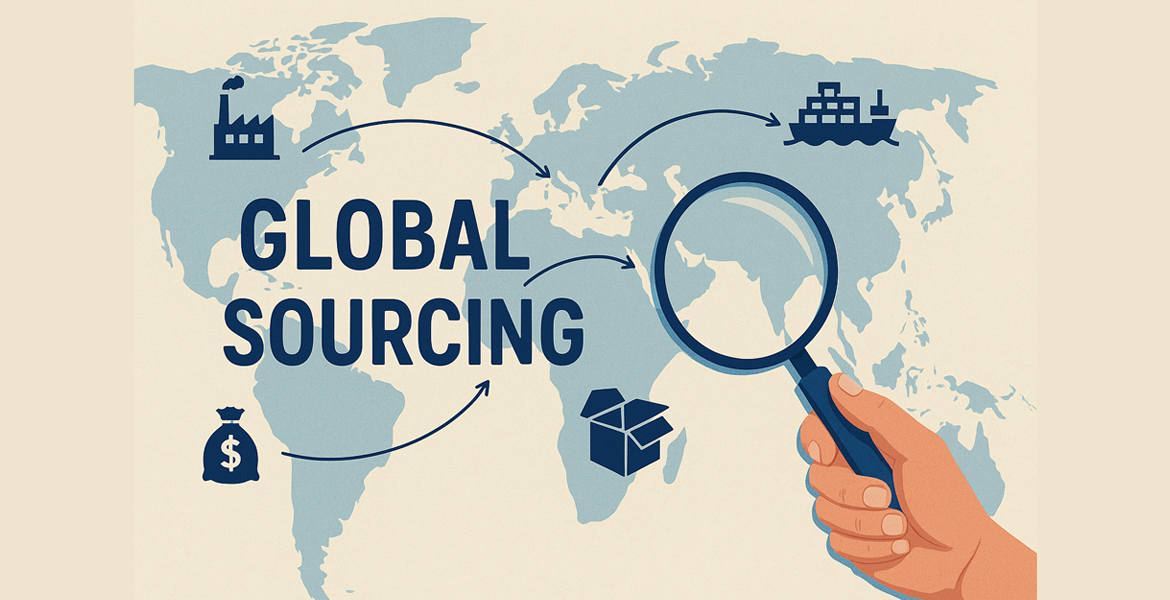
The Most Overlooked Decision in Global Sourcing—and Why It Matters
The hidden lever behind your landed cost
Two companies buy the same product from the same supplier, at the same unit price. One walks away with a healthy margin. The other barely breaks even. The difference isn’t negotiation skill or volume—it’s Incoterms.
Incoterms are often treated as a technical footnote in contracts, something left to logistics teams or freight forwarders. In reality, your choice of Incoterm can quietly determine whether a deal is profitable or painful. It affects not just transportation costs, but risk exposure, cash flow, operational complexity, and even customer satisfaction.
If you import or export goods, understanding how Incoterm selection impacts your profit margin is not optional—it’s a competitive advantage.
What Incoterms really control (beyond shipping)
At their core, Incoterms define three things between buyer and seller:
Cost responsibility – who pays for freight, insurance, handling, duties, and local charges
Risk transfer – the point at which damage, loss, or delay becomes the buyer’s problem
Operational control – who chooses carriers, manages customs, and handles documentation
Each of these has direct and indirect financial consequences. The mistake many companies make is focusing only on the quoted product price, while ignoring how costs and risks are distributed across the supply chain.
The illusion of “cheaper” pricing
One of the most common traps is choosing an Incoterm that looks cheaper on paper.
For example, EXW (Ex Works) often comes with the lowest unit price. But under EXW, the buyer assumes responsibility almost immediately—pickup, export clearance, freight, insurance, and everything that follows.
What’s frequently overlooked:
Higher logistics costs due to lack of scale
Delays from unfamiliar export procedures
Unexpected charges from multiple intermediaries
Greater exposure to damage before cargo even leaves the supplier’s premises
By the time goods arrive, the “cheap” EXW price may have quietly eroded your margin.
Margin erosion through poor risk allocation
Profit margins aren’t just eaten by visible costs—they’re destroyed by unmanaged risk.
Consider FOB (Free on Board) versus CIF (Cost, Insurance, and Freight). Under FOB, the buyer takes on risk once goods are loaded onto the vessel. Under CIF, the seller arranges insurance and freight, transferring risk later.
If you lack strong logistics partners or internal expertise, FOB can expose you to:
Underinsured cargo
Claims disputes
Costly delays at transshipment ports
Emergency re-routing expenses
One damaged or delayed shipment can wipe out the profit from multiple successful orders. Sometimes, paying slightly more under CIF or DAP is actually margin protection, not margin loss.
Control vs. cost: the strategic trade-off
More control doesn’t always mean better outcomes.
Advanced importers often prefer FCA, FOB, or FAS because they want to control freight rates, carriers, and transit times. This makes sense—if you have:
Negotiated freight contracts
Strong freight forwarders
In-house logistics expertise
Without those, the same Incoterms can become a liability. Poor routing, inefficient consolidation, or missed compliance steps can introduce hidden costs that compound over time.
On the other hand, DAP (Delivered at Place) or DDP (Delivered Duty Paid) shift complexity to the seller. While the unit price is higher, these terms:
Simplify landed cost forecasting
Reduce administrative overhead
Improve cash flow predictability
For small to mid-sized businesses, this operational simplicity often translates into stronger net margins—even at a higher headline price.
Cash flow: the silent margin killer
Incoterms also determine when you pay—not just how much.
Under buyer-controlled Incoterms, you often pay freight, duties, and local charges upfront, long before goods are sold. This ties up working capital and increases financing costs.
Seller-delivered Incoterms may:
Bundle costs into the invoice
Delay cash outflows
Reduce reliance on short-term credit
Over time, improved cash flow efficiency can be just as valuable as cost savings, especially in volatile markets or during expansion phases.
Customs, compliance, and penalty risk
Customs mistakes don’t just cause delays—they cause fines, storage charges, and sometimes shipment seizures.
Incoterms influence:
Who is responsible for export and import clearance
Who bears the cost of misclassification or documentation errors
Who absorbs penalties if regulations change
Choosing an Incoterm misaligned with your compliance capabilities can turn a profitable deal into a regulatory nightmare. This is particularly critical in markets with complex import rules, frequent policy changes, or high enforcement activity.
Customer experience and downstream impact
If you’re selling onward—especially B2B—Incoterms affect your customers too.
Late deliveries, surprise charges, or damaged goods don’t just hurt one transaction. They damage trust, reduce repeat business, and pressure you to discount future orders.
Strategic Incoterm selection helps:
Stabilize delivery timelines
Reduce customer disputes
Protect long-term revenue, not just per-shipment margin
How to choose Incoterms that protect profit
There is no universally “best” Incoterm—only the most appropriate one for your situation.
Ask these questions before deciding:
Do we truly understand our end-to-end landed cost?
Do we have the capability to manage logistics and compliance ourselves?
Is our priority unit cost, cash flow, risk reduction, or speed to market?
How volatile are freight rates and regulations in this trade lane?
The right Incoterm aligns commercial strategy with operational reality.
Final thought: Incoterms are financial decisions
Incoterms are often treated as legal fine print. In truth, they are financial instruments embedded in your contracts.
Choosing the wrong one can quietly drain margins through inefficiency, risk, and distraction. Choosing the right one can improve predictability, protect profit, and give you a strategic edge in international trade.
If you want stronger margins, don’t just negotiate harder on price—negotiate smarter on Incoterms.
Share:
newsletter
Subscribe To Our Newsletter
Be ready for the ever-changing world.
Get practical insights on cross-border expansion, market entry strategies, digital growth, and Southeast Asia business trends delivered straight to your inbox.
We help businesses expand confidently across India, Vietnam, and Southeast Asia through market entry consulting, growth marketing, and technology-driven execution.
Information
Contact Us
- 455–455A–457 Hoàng Sa, Phường Võ Thị Sáu, Quận 3,Thành phố Hồ Chí Minh, Việt Nam – 700000
- contact@indoviet.vn
- +84-876761740
- +84-562107246
© 2025 IndoViet Consultants & Commerce Co. Ltd. All rights reserved.